


 1. The Gregorian calendar, an unfinished reform :
Introduced about 440 years ago, the Gregorian calendar was a big step forward in organizing time. Yet, this reform didn’t go all the way: it kept several flaws inherited from the Julian and Roman calendars, which are more than two thousand years old.

2. The month of February, a strange month:
With its 28 days, February is a real oddity. This peculiarity goes back to the Roman calendar, which at the time had 355 days—four months of 31 days, seven of 29 days, and one month of 28 days. The Romans, being superstitious, believed that even numbers brought bad luck. So they favored months with an odd number of days. However, to reach a total of 355 days, there had to be a month of 28 days. February, associated with the dead and funeral rites, was chosen to carry this exception.
It must be said that this old superstition has left a curious mark on our current calendar.

3. Unequal length of months:
The Gregorian calendar has kept a very irregular distribution of days: one month of 28 or 29 days, four months of 30 days, and seven months of 31 days. Why are months different lengths? This irregularity forces us to constantly check the number of days in each month to plan our activities and deadlines.

4. Birthdays always on different days:
In the Gregorian calendar, a birthday changes the day of the week from one year to the next. A birthday that falls on a Monday this year might fall on a Wednesday the following year. This makes it tricky to keep track because annual events, meetings, and activities never fall on the same day of the week from one year to the next.

5. An uneven distribution of quarters:
The four quarters of the year don’t have the same number of days: the first has 90, the second 91, and the last two 92. This uneven distribution makes financial, economic, and statistical comparisons from one quarter to another tricky. Adjustments are often needed to account for the different number of days and get truly meaningful comparisons.

6. Complex Planning:
Every year, schools, businesses, and organizations have to readjust their calendars and schedules. The dates keep shifting from one day of the week to another, making it impossible to repeat the exact same annual schedule.
Why start over every year with something that could be permanent?

7. Weeks that span two months:
In the Gregorian calendar, the weeks at the beginning and end of a month usually span two months. This situation unnecessarily complicates the preparation of weekly and monthly reports, as well as tracking activities and results.

8. A complicated perpetual calendar:
Every year requires a different setup of our calendar. You have to use one of the 14 possible calendar templates. This situation forces us to renew our calendar every year, whereas a true perpetual calendar could keep exactly the same structure from one year to the next.

9. Unnecessarily complicated administrative management:
Months of varying length make many repetitive tasks more difficult: preparing medications, renewing prescriptions, managing subscriptions, payroll, statistics, budgets, billing, etc. These activities constantly have to account for the different number of days in each month and in reference periods.

10. A somewhat irrational historical origin:
The Gregorian calendar inherited several features from the Roman and Julian calendars, whose origins go back over two thousand years. It is therefore the result of many historical adjustments rather than a design based on principles of simplicity, regularity, and logic.
 1. Months All the Same:
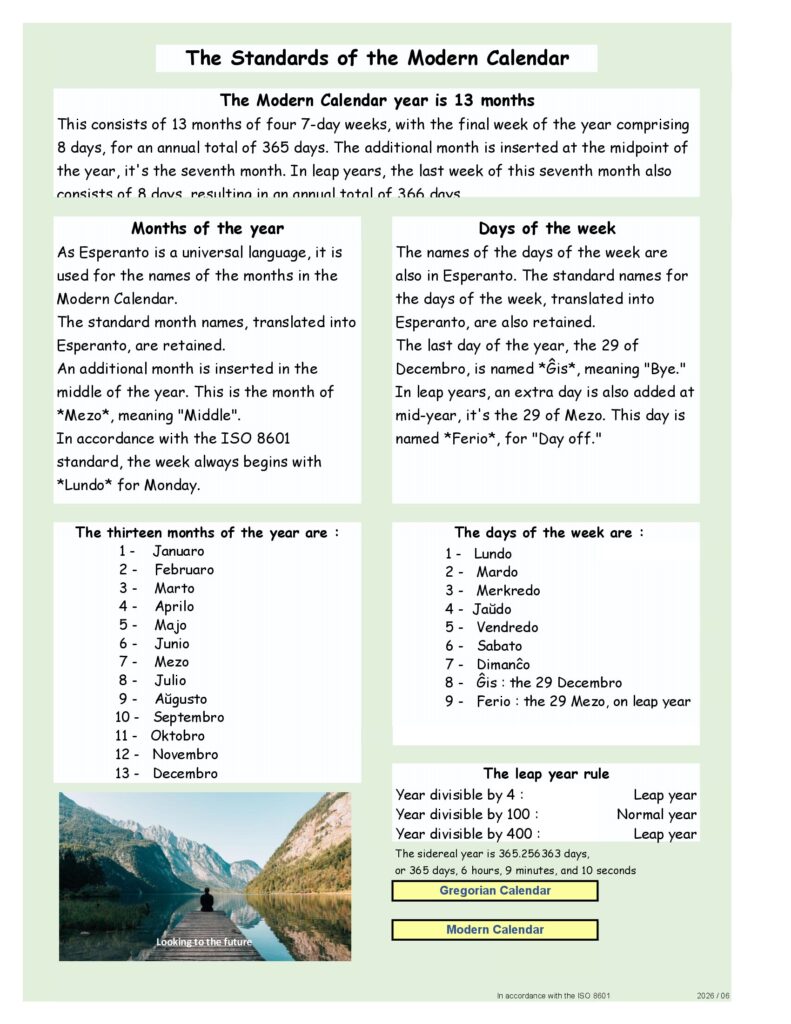
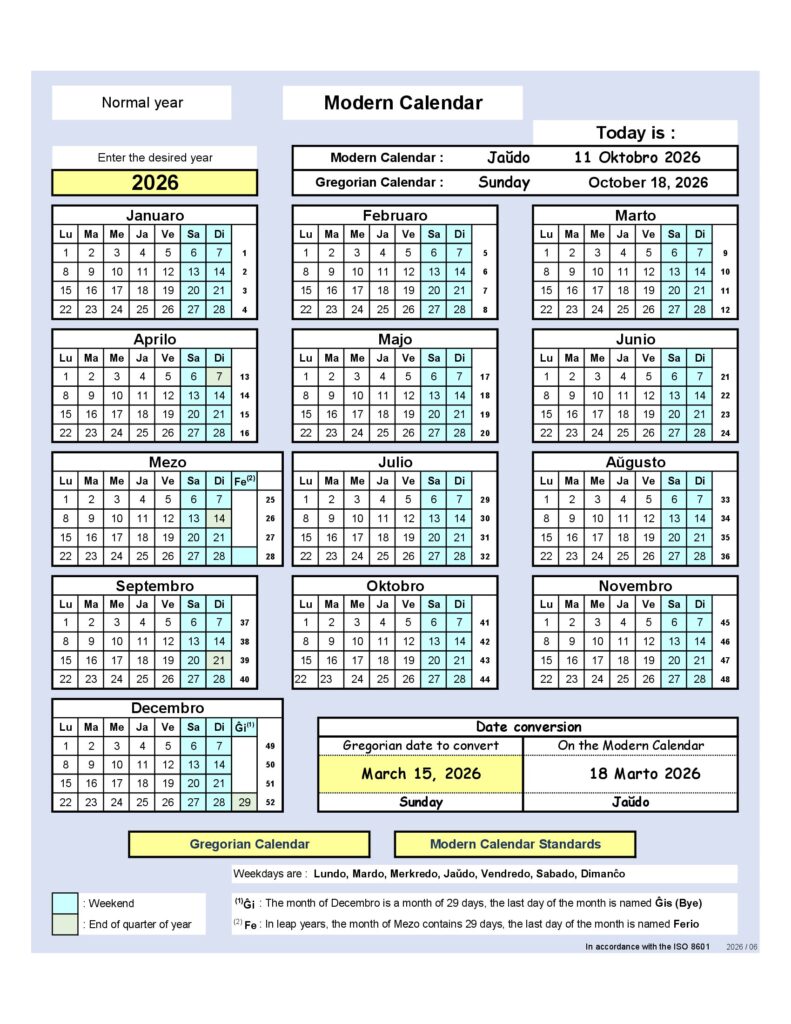
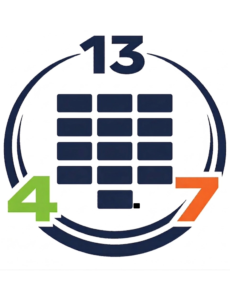
The Moderne Calendar has 13 months of 28 days each, which is exactly 4 weeks of 7 days per month. So each month is the same length, always starts on a Monday, and always ends on a Sunday.

2. The use of Esperanto:
For the sake of neutrality, simplicity, and universality, the names of the days and months in the Modern Calendar are in Esperanto. In addition to being a universal language, Esperanto avoids possible confusion with other calendars in use.

3. One last 8-day week:
To complete the 365-day year, the last week of the year exceptionally has 8 days. This extra day, called Ĝis « goodbye » in Esperanto, is a special day, independent of the usual weekly cycle.

4. An extra day in a leap year:
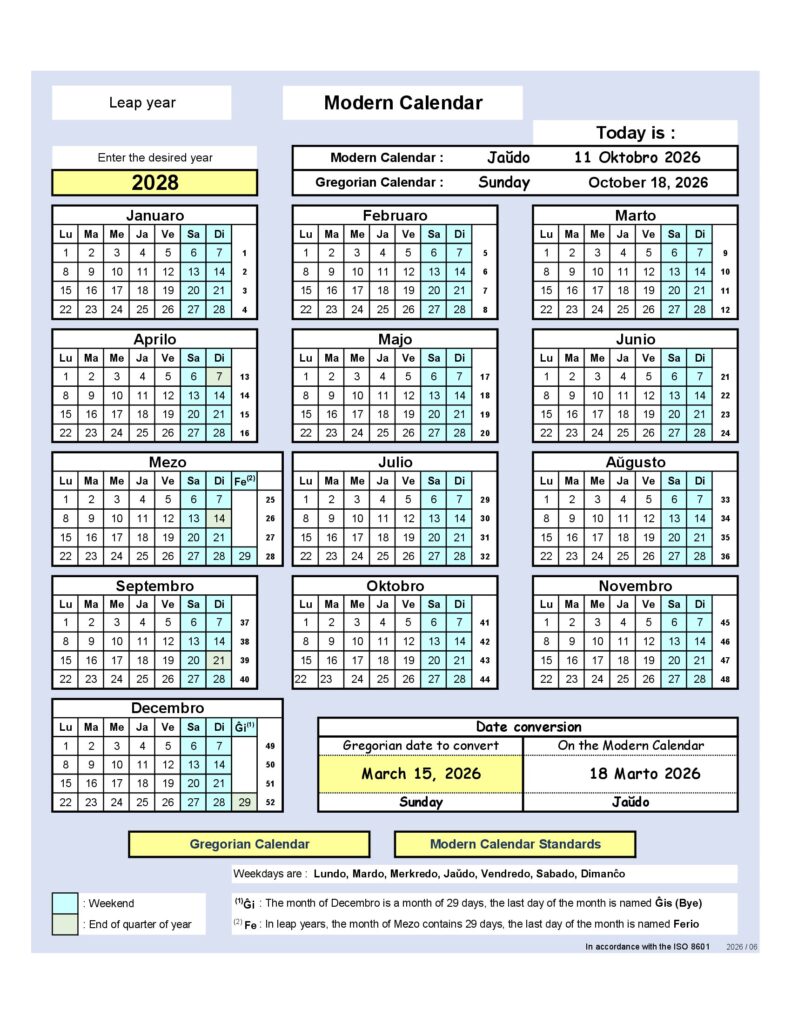
In leap years, an extra day is needed to complete the 366 days of the year. In the middle of the year, the last week of the seventh month then has 8 days. This day is called Ferio « holiday » in Esperanto.

5. In agreement with ISO 8601:
According to the international standard ISO 8601, the week starts on a Monday and ends on a Sunday. This also reflects a natural organization of time: work first, then rest.

6. Only two possible models:
Two copies of the calendar: one for regular years and one for leap years. The structure of the months and weeks always stays the same.
A single calendar with just two variations.

7. A key advantage of the Modern Calendar:
Birthdays always fall on fixed days. Thanks to the calendar’s regularity, each date always corresponds to the same day of the week. This stability also applies to appointments, meetings, events, and other recurring activities.
One date, one day of the week, forever.


